Florida State University Athletics
Behind The Jersey: The Gift That Reaches Every Seminole
9/24/2026 9:01:00 AM | Athletics
What they don't see is the student-athlete who hasn't slept in three days, who is carrying the weight of a family's expectations across two time zones, who smiles for the camera and falls apart in private.
College athletics has always celebrated what happens on the field. For too long, it has been quiet about everything else. Florida State Athletics is not being quiet.
Several years ago, FSU built something different — a dedicated Licensed Psychologist embedded inside the athletic department itself, partnered with specialists who speak the language of competition and understand the silence that lives behind it. Not a referral. Not a hotline number on a flyer. A real place, with real people, where a Seminole can walk in and be met without judgment.
But this is not only a story about college athletics. It is a story about the world these young people are growing up in. The NIL era and the transfer portal have changed the landscape of college sports — that much everyone agrees on. What gets less attention is that the world itself has changed, in ways that have quietly eroded the things that kept human beings mentally healthy.
Americans eat faster, shop without leaving home, and have packages delivered before they have time to think about what they ordered.
|
"We all have struggles or know someone who has been impacted by mental health issues. This isn't about one team or one athlete - it's about ensuring all voices are heard."
— Brian Cauthen, FSU Alumnus |
Face-to-face socializing has dropped by nearly a third since 2003. For people under 25, time spent gathering with other human beings has fallen by almost 70 percent over the same period.
The dinner table, the front porch, the after-practice carpool, the ordinary moments of human connection that once formed the scaffolding of mental health, are disappearing. We have replaced them with speed and convenience, and we are paying a price that shows up not on a receipt, but in the quiet struggles of the people around us.
Student-athletes are not immune to any of this. They are living it, like everyone else, while also carrying everything that comes with competing at the highest level of college sports.
Inside the Moore Athletic Center, that response has a name: the Mental Health & Sport Psychology Program — a program built to meet a student-athlete anywhere along the continuum of well-being, not just in crisis.
At one end of that continuum is an athlete performing at their peak, clear-headed and resilient. At the other are the quieter struggles — anxiety before a big exam, the grief of a season-ending injury, the loneliness of being hundreds of miles from home, the loss of a loved one, or childhood trauma.
FSU's Athletics Mental Health program is built to meet a student-athlete anywhere along that line, not just in crisis.
What that looks like in practice is broader than most fans realize. Licensed clinicians provide individual and group counseling on everything from body image and disordered eating to the psychological toll of injury, substance use, and the everyday weight of academic and athletic demands.
This past academic year, student-athletes from every single varsity program at Florida State accessed these services — not isolated cases, but a sustained, department-wide reality. The need does not belong to one sport, one roster, or one kind of athlete. It belongs to all of them, because they are, first and always, people.
That reach is a credit to the program's foundation — and it is also where the next challenge begins. The in-house team currently consists of two clinical full-time staff, supported by four contracted community providers and two mental performance consultants. It is a program built on real expertise and real care. But as demand grows — and the issues student-athletes bring through the door grow more complex — the gap between what the program offers today and what it could offer tomorrow becomes the most important question facing FSU Athletics' mental health future.
That is the gap the Cauthen Fund's gift would like to close.
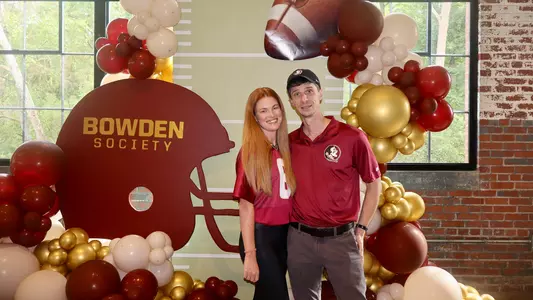
Brian Cauthen is the Donor Representative of the Cauthen Fund and is tasked with allocating resources across charitable and educational institutions. When he began exploring giving opportunities at Florida State, he didn't start with an idea of his own. He started by asking questions — about what FSU Athletics already had in place, what was working, and where the strain was greatest.
What he found surprised him: a department that had already made mental health a real priority, but one that was stretched thin against the scale of need. For Brian, that was the opening. Not to create something new, but to remove the barriers that were keeping a strong program from becoming a complete one.
The gift is structured to do exactly that; funding additional clinical staffing and a dedicated office suite that lowers the barrier to walking through the door before a struggle becomes a crisis. It is, in his words, a needs-based gift: clearing the path for FSU's own experts to do more of what they already do well, reaching every athlete — whether that's working through trauma, managing disordered eating, or figuring out why a golfer can't make a four-foot putt. Mental health, Brian points out, isn't only about crisis — sometimes it's about understanding who you are.The impact of Brian's gift will not announce itself in a press conference or a ribbon cutting. It will show up quietly — in a shorter wait time, in a door that opens a little easier, in a student-athlete who finds their way to a chair across from a clinician before a hard week becomes a harder month. That is the nature of this work. The results live in private moments that the scoreboard will never capture, and that is precisely why it matters.
"What we are building here is not just a service, it is a culture. Every student-athlete who walks through our door is making a courageous choice. Our job is to make sure that choice is as easy as possible to make, and that when they arrive, someone is ready for them. Brian's gift allows us to show up for more of our athletes, more consistently, at the level they deserve."
— Dr. Keely Kaklamanos, Director of Athletics Mental Health and Sport Psychology, FSU Athletics
For Brian, the hope is simple and personal. He does not consider himself an expert on mental health. He is an FSU alumnus, a grandson, a steward of a legacy built on the conviction that giving back is a privilege — and that the privilege belongs to those willing to act on it.
"I just wanted to know what was needed. When I saw what FSU was already doing, and what was possible with more support, it wasn't a complicated decision. I hope someone reads this and asks the same question: How can we provide the best standard of care for our student-athletes?"
— Brian Cauthen
"We talk a lot about developing the whole student-athlete. That has to mean something. It cannot be a phrase we use at a press conference and then walk away from. Investing in mental health is investing in the people we are responsible for — and this program, and Brian's belief in it, reflects exactly the kind of institution Florida State is committed to being."
— Bruce Warwick, Interim Director of Athletics, Florida State University
And yet, even with this gift, FSU Athletics is clear-eyed about the road ahead. The need among student-athletes is not shrinking. The complexity of what they carry — the anxiety, the pressure, the loneliness of performing on the largest stage of their young lives — is not going away. The program that Brian's generosity is helping to grow is not a finish line. It is simply the next step.
Florida State's commitment is not to reach a number of clinicians or a square footage of office space. It is to reach every Seminole who needs support — today, and in whatever form that need takes tomorrow. Behind every jersey is a person. This program exists to make sure they are never forgotten.
THE CAUTHEN FAMILY LEGACY
Brian Cauthen's gift didn't begin with him. It began nearly a century ago, in a country general store in Winter Haven, Florida, where his grandfather, the late Irvin L. Cauthen, was raised in the 1930s.
Irvin worked his way through Georgia Tech as a part-time janitor, sleeping for free in a supply room,
before double-majoring in engineering and business. He married his wife the same afternoon he graduated — at First Baptist Church in downtown Atlanta.
As a young professional, Irvin had an engineering career where he worked for NASA but ultimately returned to his roots, building and operating gas stations. Over time that grew to numerous stores and locations across Florida, Georgia and the Carolinas and became a great success.
In 2001 Irvin and his wife Jorene established the Irvin L. and Jorene J. Cauthen Donor Advised Fund, commonly known as "the Cauthen Fund" through the Foothills Community Foundation located in Anderson, SC. Irvin served on the board for 18 years. Today, Brian serves on that same board and is the fund's representative.
For years, the Cauthen family's gifts went unannounced. This one is different — not for recognition, but because Brian hopes telling this story inspires others to ask the same question he did: how can I help?To learn more about supporting the FSU Athletics Mental Health & Sport Psychology Program, contact Seminole Boosters at seminoleboosters.com.