Florida State University Athletics
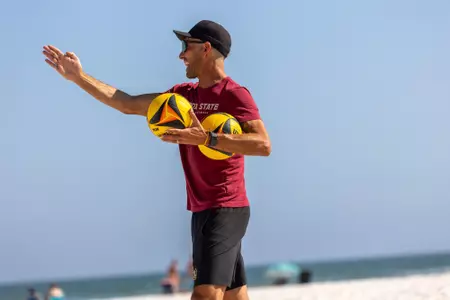
Still Learning: Two-Time Olympian Lucena Enters 4th Season at FSU
11/7/2024 4:08:00 PM | Women's Beach Volleyball
TALLAHASSEE, FLORIDA – Leo Georgi was the videographer shooting the interview for this story. Like all videographers shooting promotional pieces for the organization they're representing, he wanted, as he said laughing afterwards, a bit of propaganda, some good ole fashioned chest-thumping, a grandiose listing of accomplishments, a "here's all that I've done and why I am one of the best."
The potential material was not in short supply. Key word: potential.
Georgi was shooting a piece on Nick Lucena, Florida State's decorated assistant coach who is also perhaps the unofficial leader for most overqualified assistant beach volleyball coach in the United States.
He knew Lucena, too. Not well, but enough to understand that here is a two-time Olympian, a man who will be considered one of the best defensive players of his generation, a 6-foot-1 underdog who laid waste to expectations on an annual basis.

Yet there was a problem: Georgi could not, for the life of him, get Lucena to give himself credit for any of his successes.
Those two Olympics he went to? Well, that was because Lucena had the privilege of playing behind Phil Dalhausser, arguably the greatest blocker of all-time. What about the Olympic Games in 2012? The one he didn't make but still finished seventh in the world, not qualifying only due to an obscure rule limiting countries to their top two teams? That came thanks to Matt Fuerbringer, whose hand work at the net is also some of the finest in the game, who reminded Lucena a lot of a partner who came before him in Sean Scott. Speaking of, did Lucena mention how good Sean Scott was? One of the best.
And on and on Lucena went, singing ebullient praises about everyone save for himself.
Georgi was exasperated. He was not here to put together clips of Dalhausser or Scott or Fuerbringer. He was here to highlight the immeasurable talent of Florida State's coaching staff, where the head coach, Brooke Niles, is the all-time winningest coach in the sport's NCAA history, and its assistant, Lucena, has accomplished more as a player than any other program's head coach, save for Todd Rogers at Cal Poly, an Olympic gold medalist and good friend of Lucena's.
Yet it is that very humility, the sheer inability to thump his chest and list his accomplishments with a Hollywood grin for the camera, that is what makes Lucena unrivaled in his position.
"He's the humblest person I have ever met in my life," said Paige Kalkhoff, a redshirt senior who is coming off an ACL injury and has worked one-on-one with Lucena since she could return to the sand earlier this fall. "Being able to grow up and watch him play and now being able to be coached by him every day is the biggest blessing."

She's a regular in Lucena's office, Kalkhoff, as are many of the Seminoles. At least once a week, she will pop in to say hi and every now and then find her gaze drawn to the corner, where Lucena's 26 FIVB medals hang in a shadowbox, under his three Gstaad Cowbells – the most coveted prize in beach volleyball outside of an Olympic medal – won at the Gstaad Major. If it were up to him, they'd likely be in his garage or collecting dust in a long-forgotten bin somewhere. Even those cowbells are hidden under thank-you notes from players, of which there are many.
It is as if he is intent on making it as easy as possible to forget that he won nine gold medals on the FIVB World Tour – all after the age of 35 – and was ranked, with Dalhausser, the No. 1 team in the world for months at a time.
But then you get on the sand with him, and you hear the machine-gun fire of his feedback, talking, talking, constantly talking, you see him jump in a drill for a rep, feel the contagious intensity of his energy, and suddenly it's impossible to forget what a supreme talent Nick Lucena was – and still could be – as a player, the same supreme talent that is turning him into a highly sought-after coach.
"His knowledge of the game is unlike anything I have ever seen," Kalkhoff said. "He is truly the most down to Earth person."
For some athletes or coaches, this on-camera humility, the aw-shucks down-to-Earth essence Kalkhoff mentioned, is performative, inauthentic. Turn on the cameras, and out comes the shiny veneer. Soon as the camera is off, it's a different human being.
Lucena is just Lucena. He even apologized throughout the interview for being so very him.
"I just speak the truth," he said, laughing.
He is the same on camera as off. Which means that to goad him into talking about himself, you almost have to trick him. When asked about his coaching philosophies, the pillars he uses as a foundation for drills and practices and communicating with the Seminoles, he shrugs and practically second-guesses almost every drill he has ever run.
"I'm still learning, still trying to figure everything out," he said. "I don't think there's a right way to do it – Dain [Blanton, the head coach for USC] probably has the perfect way to do it. It's ever-evolving, and we're just trying to teach these kids how we were taught and what I'm learning is that's not for everyone. So you do have to learn how to adapt and be mindful and understanding where the student-athlete is coming from and how we can try to get the best out of them, find a balance."
In the space of less than 30 minutes, he used the phrase "I'm still learning" half a dozen times. Which speaks to his humility and open-mindedness as a coach more than any philosophy he could have spouted. How many two-time Olympians would be humble and secure enough to allow a teenager and their response to certain feedback or drills or practice games to alter how they coach that individual, rather than lean on the "this worked for me" or "back in my day" approach?
Maybe one, and his name is Nick Lucena.
"I'm learning every day," he said. "How can we get better for next season, and we'll try not to make the same mistakes we did last season and see how it goes."
In all three years Lucena has assisted Niles, Florida State has eclipsed 30 wins and won more than 75 percent of its matches. They have not, as they are consistently reminded, won a National Championship, but here is where Lucena's experience may be the most valuable.
Twice, Lucena made the Olympic Games. He didn't medal in either, a punchline his brother so loves to deliver over late-night phone calls. Beach volleyball is a quadrennial sport, rising meteorically in popularity for two weeks every four years at the Olympic Games before disappearing from the national spotlight until the next Games. Lucena's experiences as a player taught him to value the in-between, the nearly 300 professional tournaments he played that were not the Olympic Games. He approaches the NCAA Championships much the same way: Sure, it would undoubtedly be a massive success to win a National Championship, just as winning an Olympic gold medal would have been. As a player and coach, he wants both of those things.
But he knows, better than anyone in the sport, that the true value is the in-between. It's in the practices, the lifts, the film, the reps, the nearly 40 matches they will play outside of the NCAA Championships, the growth of the young women as human beings off the court.
"I think that's the most important part," he said. "Once they leave, they're going to be better humans moving forward and learning. We have kids that have been there four or five years and haven't played but continue to go out there, do everything we're asking, work like professionals, and still not having everything they want. You know they're going to grind in life."
And on the court? His perspective is much the same: Zoomed out, viewed with the wide lens.
"If you were to take our season last year, I would say it's one of our most successful seasons we've had," he said of the 31-8 team who won a CCSA Championship and finished fifth at the NCAA Championships. "We played everyone. Everyone had a win. Then you take a fifth in the last tournament of the year and everyone says, 'You blew it!' It's a success for me.
"It's so hard and it's hard to win in anything, and when it does happen, it's magical and you have to appreciate it. It all comes down to that last tournament, and you have to perform. Same with the Olympics. Everyone makes it a big deal, and if you don't medal, everyone goes 'ah.' It's just one tournament. It's hard to win, but as soon as you win, it's the next event. It's ever evolving. You just have to be ready. Very rarely does it happen to one person or one team all the time."
But here is where Lucena allows the smallest sliver of the propaganda Georgi wanted so badly.
"We're putting the pieces together," he said, referencing strength and conditioning coach Elisa Angeles, whose hands are heavy with National Championship rings, and a highly-touted freshman class. "And it's going to happen. It's not an if, but when."